When Enough Becomes Everything: How Money Changes Meaning After 60
My neighbor Patricia traded in her luxury sedan last spring for a small practical hatchback that she paid for outright. No payments. No financing. Just a check and a title and a deep, visible exhale that I watched from my porch as she drove it home for the first time.
She told me later it was the best financial decision she’d made in twenty years.
Not because the car was better. It wasn’t. It was smaller and quieter and didn’t have the heated seats she’d loved for a decade. But she said something I’ve been turning over ever since. She said, “Marky, I didn’t realize how much energy I was spending just keeping up with myself.”
Keeping up with yourself. I’ve been thinking about that phrase ever since.
Something Shifts
There is a change that happens in a person, quiet and gradual, somewhere in the years after sixty. It doesn’t announce itself. It doesn’t arrive with clarity or resolution. It just slowly becomes apparent that certain things that used to matter have started to feel heavy, and certain things you once overlooked have started to feel like the whole point.
For most of my working life, money and what it could provide felt like a measure of something. Security, yes, but also standing. The right address. The right car in the driveway. Vacations worth mentioning. A kitchen that looked like the ones in magazines. None of it was dishonest. I worked hard and I wanted nice things and there is nothing wrong with that.
But somewhere past sixty, I noticed I was tired of maintaining the idea of a life more than I was tired of living one.
The keeping up, not with neighbors, not even with expectations, but with the version of myself I’d been performing for decades, started to feel like a second job I had never agreed to take.
What Peace Actually Costs
People talk about peace of mind as though it’s free. It isn’t. Real peace of mind is the result of choices, sometimes small and daily, sometimes large and uncomfortable, to stop spending your emotional energy on things that don’t return it.
I have a friend named Gloria who spent thirty years in corporate finance. Brilliant woman, sharp as anyone I’ve ever met. When she retired, she sold her large house and moved into a two bedroom condominium twenty minutes from her youngest daughter. People in her circle thought she had lost something. She knew she had found something.
She told me her monthly expenses dropped by more than half. But it wasn’t the money that changed her, not exactly. It was what the simplicity made room for. She sleeps better. She reads again, real books, full ones. She has dinner with her daughter on Thursdays and she says those Thursday evenings are the best hours of her week.
She’s not living smaller. She’s living cleaner. And there’s a difference that’s hard to explain to someone who hasn’t felt it yet.
The Changing Texture of Enough
After sixty, many of us begin to develop a different relationship with the word enough. For most of our lives, enough was a threshold we were always approaching but never quite reaching. There was always a next thing, a next level, a next version of stability just a little further out.
Then, at some point, enough stops being a destination and becomes a description. You look around at your actual life and you realize that what you have, the people in it, the rhythms of it, the smallness and the warmth of ordinary days, is not a consolation prize. It is the thing itself.
I don’t spend money the way I used to. Not because I can’t, but because I’ve stopped wanting what I used to want. The expensive dinner out doesn’t taste better than the one I make at home on a Sunday with my husband. The new furniture doesn’t feel as comfortable as the old couch we’ve had for sixteen years, the one that knows the shape of us.
This isn’t deprivation. This is something else entirely. It’s the quiet discovery that I was already home and didn’t know it.
Relationships Do What Things Never Could
What I’ve come to understand, slowly and without any particular epiphany, is that the emotional security I spent decades trying to buy through accumulation was never actually available for purchase.
It was always in the other direction.
The relationships I invested in, not financially, but with time and presence and the willingness to show up even when I didn’t feel like it, those are the ones paying out now in ways I can’t quantify. My sister who calls just to say she was thinking of me. The neighbor girl who brings me tomatoes from her garden every August. My oldest friend Paulette, who I have known since we were young women with loud opinions and cheap shoes, who still makes me laugh until my face hurts.
None of that cost money. All of it required something more valuable than money. And in this season of life, that investment feels like the wisest one I ever made.
A Different Kind of Rich
I used to believe that financial peace meant having enough that you stopped thinking about money. I understand now that’s not quite right.
Financial peace, real peace, is when money returns to its proper size. When it becomes a tool again instead of a scoreboard. When you can tend to it carefully without letting it crowd out everything else. When you stop measuring your life in what you have and start measuring it in how it actually feels to be living.
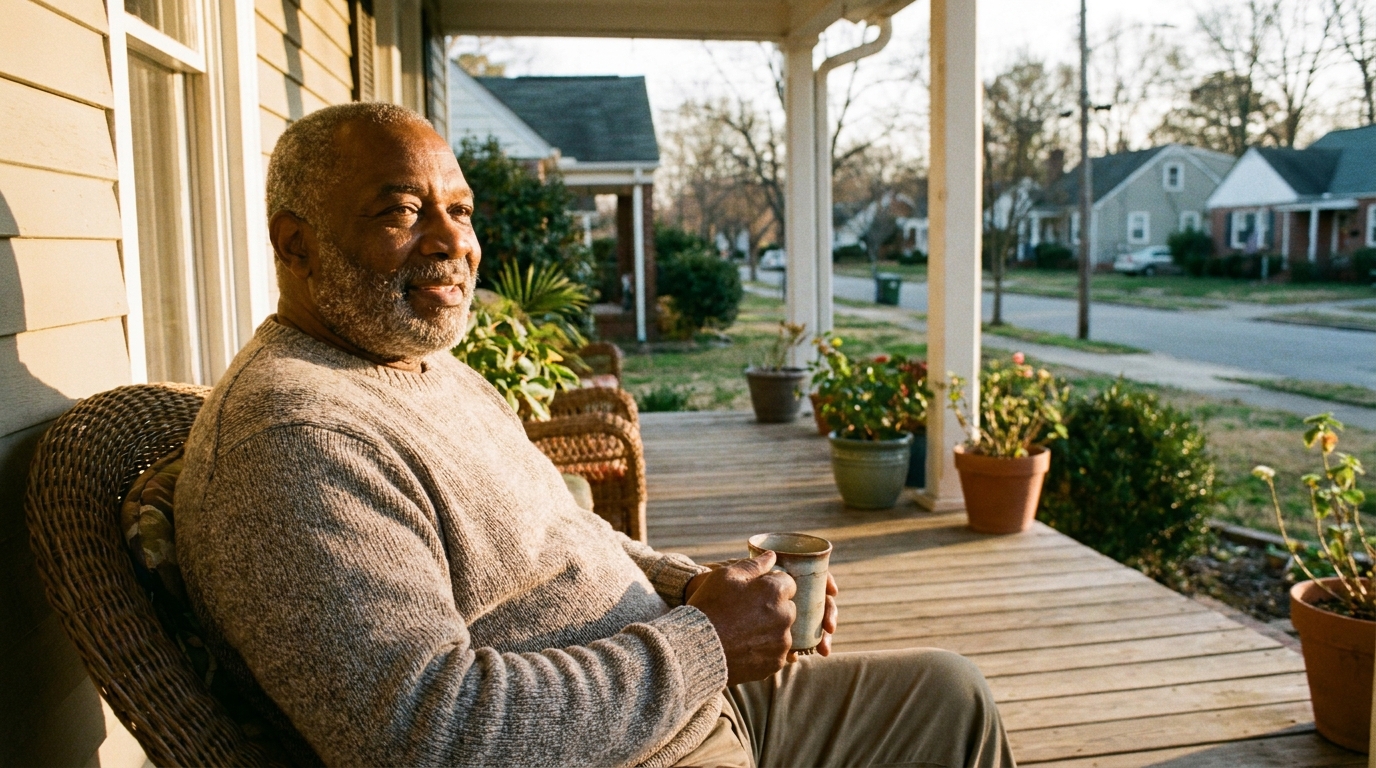
Most mornings I sit on my back porch with coffee before the day gets busy. The yard isn’t fancy. I have a bird feeder my husband put up three springs ago that lists slightly to the left and that I refuse to let him fix because the birds don’t seem to mind and I’ve grown fond of its imperfect lean. There are two chairs out there, ours, weathered and familiar. The light comes through the oak tree at an angle that only exists for about twenty minutes and I try not to miss it.
That twenty minutes doesn’t cost anything. It is also, if I’m being honest, the richest part of my day.
Patricia was right. There is something quietly powerful about not spending your energy keeping up with yourself.
Some of us had to get older to figure that out. I think that’s okay. Better late than not at all.